The First TSCM Tool Is Good Intelligence
When an organization considers Technical Surveillance Countermeasures (TSCM), the conversation often begins with a familiar question: “Who can perform a bug sweep?” It’s a reasonable question, but it shouldn’t be the only one. So, to put it in “bug” terms, TSCM involves checking for hidden microphones, cameras, and other devices that could give someone an uninvited seat at your next sensitive conversation.
A TSCM assessment must consider why and how someone might seek access to sensitive conversations or information. Ultimately, that work should begin before any equipment is turned on, since an unknown device or wireless signal is only part of the picture. A thorough understanding of an individual’s or organization’s sentiment, risk environment, protected information, access points, technology, and any other changes helps the assessment team determine where to look and how to interpret what it finds.
Specialists should begin by asking themselves two questions:
What are we protecting, and why might someone want it? For example, a boardroom used for confidential acquisition discussions may need different precautions than a room used for routine meetings. Executive offices, research facilities, legal meetings, and temporary hotel workspaces each present different concerns. Business transactions, executive travel, personnel changes, or heightened public attention can change what information is at risk and where it could be exposed.
Protective and open-source intelligence (OSINT) research using publicly available information can strengthen the TSCM process. Before examining a physical environment, one should consider what information someone might seek, who could benefit from it, and how they might access it. This context can help TSCM specialists determine which rooms, devices, or access points warrant closer examination.
For example, public travel details or meeting announcements may reveal where executives often meet or will discuss sensitive business. Security teams should share that context alongside recent renovations, new technology, contractor visits, personnel changes, suspicious inquiries, or unexplained device activity. This research informs the assessment; the specialist’s technical expertise is still needed to evaluate the space and its equipment.
|
IN PRACTICE An executive traveling for sensitive negotiations may use a hotel meeting room that the organization does not control. Public travel details, recent vendor access, and room changes can help the TSCM team decide which areas or equipment need the closest attention before the meeting. |
None of these factors alone confirm surveillance. Together, however, they help identify who may pose a concern, what information someone may be trying to obtain, which locations are most exposed, and when risk may be higher.
Before an assessment, establish what normally belongs in the space and how it is used. Ask yourself:
- What sensitive information is discussed there?
- Who uses the room, and who is allowed to enter?
- Have contractors, vendors, maintenance staff, or temporary workers recently worked there?
Clarify why the assessment was requested and whether it follows a specific concern, a renovation, new technology, or a change in access. Understanding what is normal makes it easier to spot something unexpected.
Looks Beyond the Signals
Being a proactive TSCM specialist involves more than reviewing an equipment list. Organizations and security teams should also ask about the people conducting the assessment:
- What practical experience and training do they have?
- How often do they perform assessments, and have they evaluated environments like yours?
- Who supervises their work and reviews their findings?
Technical knowledge matters, but so do the experience and judgment of the individual or team.
Equipment can detect a signal. However, an experienced specialist must determine where it comes from, whether it belongs in the space, and if it requires further investigation.
Consider an executive team preparing for a confidential acquisition. Background research may reveal unusual attempts to contact employees or public clues about where executives will meet. During the assessment, the specialist detects an unfamiliar wireless signal near the boardroom. That signal could originate from normal building equipment, an adjacent office, or an unauthorized device. The specialist should compare it with known devices, inspect the surrounding area, and review recent access logs and relevant security concerns before deciding whether further investigation is needed.
A credible specialist should explain how they will conduct the assessment and why each method is appropriate. Alongside “What equipment will you bring?” ask “What are you trying to determine, and how will the results help us make a decision?”
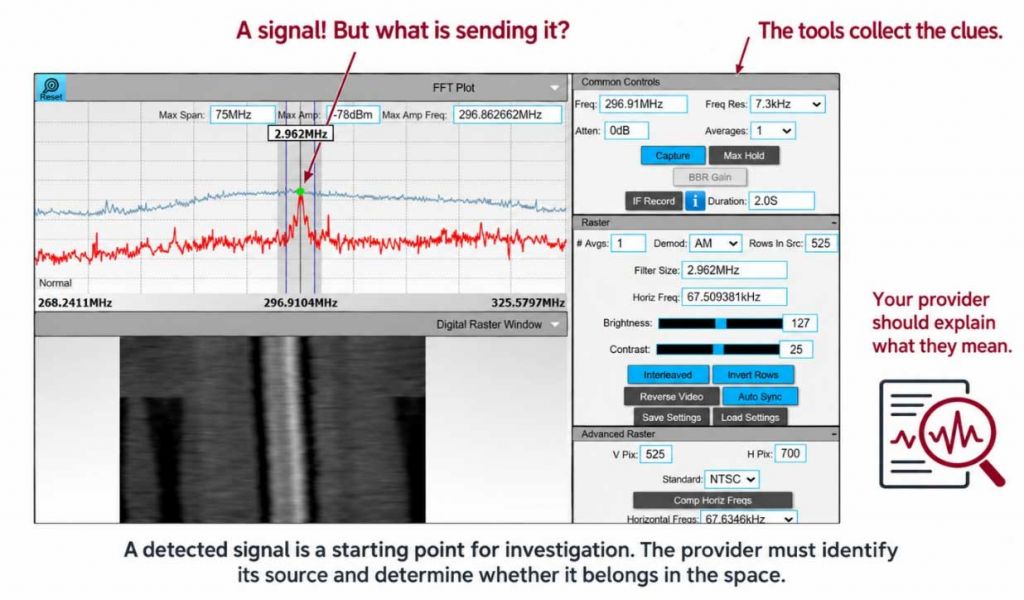
This display shows radio signals detected during an assessment. A peak shows activity at a particular frequency; it does not, by itself, confirm surveillance. An experienced specialist investigates the signal’s source, compares it with authorized equipment, and explains whether further action is needed.
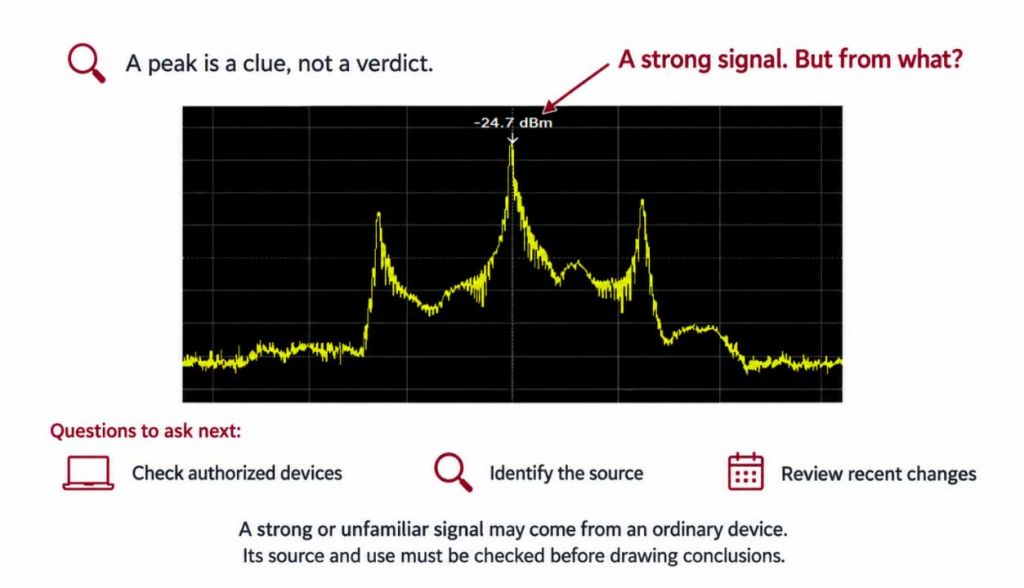
The peaks show radio-signal activity measured by the equipment. A strong or unfamiliar signal may come from an ordinary device. Check the signal’s source and use before drawing conclusions.
A radiofrequency (RF) spectrum analysis examines the radio signal’s wireless devices used to communicate and helps specialists identify signals in and around a space and investigate their possible sources. Most offices already contain signals from Wi-Fi, Bluetooth, mobile phones, audiovisual equipment, and building systems. Detecting a signal does not, by itself, show that someone is conducting surveillance.
|
IN PRACTICE An unfamiliar signal near a boardroom could come from a newly installed display, a neighboring office, or equipment that requires further investigation. The specialist compares the signal with the expected devices, physical observations, and recent changes in the room. This comparison helps determine whether the signal is expected or needs a closer look. |
Access Is Part of the Threat Picture
Surveillance risk also depends on who can enter a space, bring in equipment, or modify existing systems. Installing a device may require access to a room or its equipment. Ask who has recently performed work, who can enter unescorted or after hours, and who still has access they no longer need. Reviewing access can reveal opportunities for misuse without assuming employees or contractors are threats.
Authorized access can be deliberately misused or unintentionally create an opening for someone else. For example, an employee who admits an unverified technician may inadvertently grant an outsider access to a sensitive area without recognizing the risk. Organizations should decide in advance how they will respond if the assessment uncovers something unusual. If the team identifies a suspicious device or an unexplained change, who will secure the area, preserve relevant records, and coordinate further investigation? Agree on when to involve security, IT, legal, and human resources, and share sensitive findings only with those who need them. The investigation should establish what happened and, where relevant, how access was obtained. A clear response plan helps preserve evidence while the team determines whether the finding reflects authorized activity, a security lapse, or deliberate misuse.
| Key takeaway: Decide who owns the next step before a suspicious finding occurs. That reduces confusion, protects evidence, and helps the organization avoid premature conclusions. |
No Findings Do Not Mean No Risk
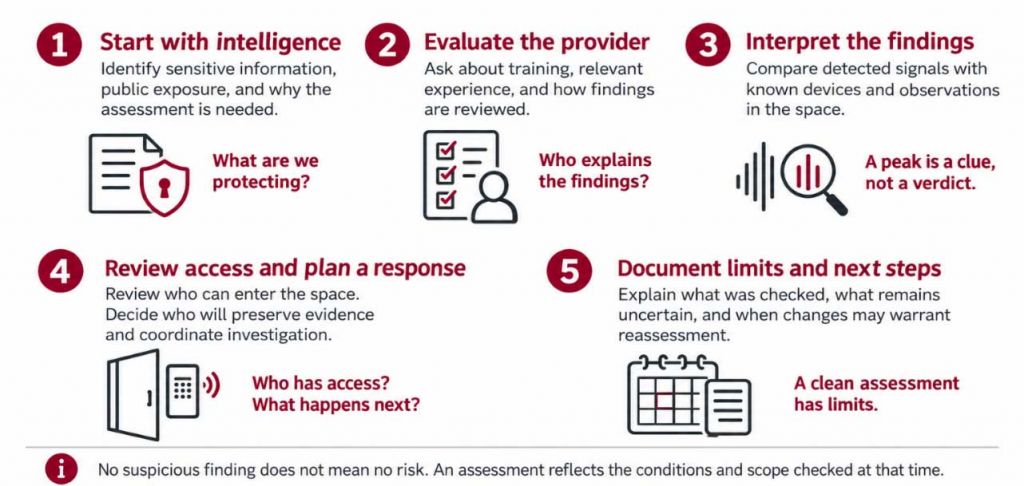
No findings do not mean there is no risk. A TSCM assessment reflects the conditions at the time of the inspection. Technology, facilities, personnel, and access can change, so a room assessed six months ago may present different risks today. The report should explain what was examined, how it was checked, what was found, what the assessment could not rule out, and what should happen next. It should not create a false sense of security.
|
Key takeaway: Decide who owns the next step before a suspicious finding occurs. That reduces confusion, protects evidence, and helps the organization avoid premature conclusions. |
Finding a hidden device is one possible outcome, but what should an organization learn when nothing suspicious is found? The real question is not: “Can you find a bug?” It should understand what was checked, what could not be ruled out, and what needs attention next. That might mean tightening access to a meeting room, verifying unfamiliar equipment, or reassessing a space after renovations.
A credible TSCM assessment provides leaders with a clear explanation of the findings and their limitations, so they can decide where sensitive conversations can take place and what precautions are needed.
A well-informed approach to TSCM begins with understanding the risks, defining clear objectives, and knowing what to expect from an assessment. AT-RISK International works with organizations to evaluate their technical security needs and determine the appropriate measures to help safeguard sensitive information and environments.